
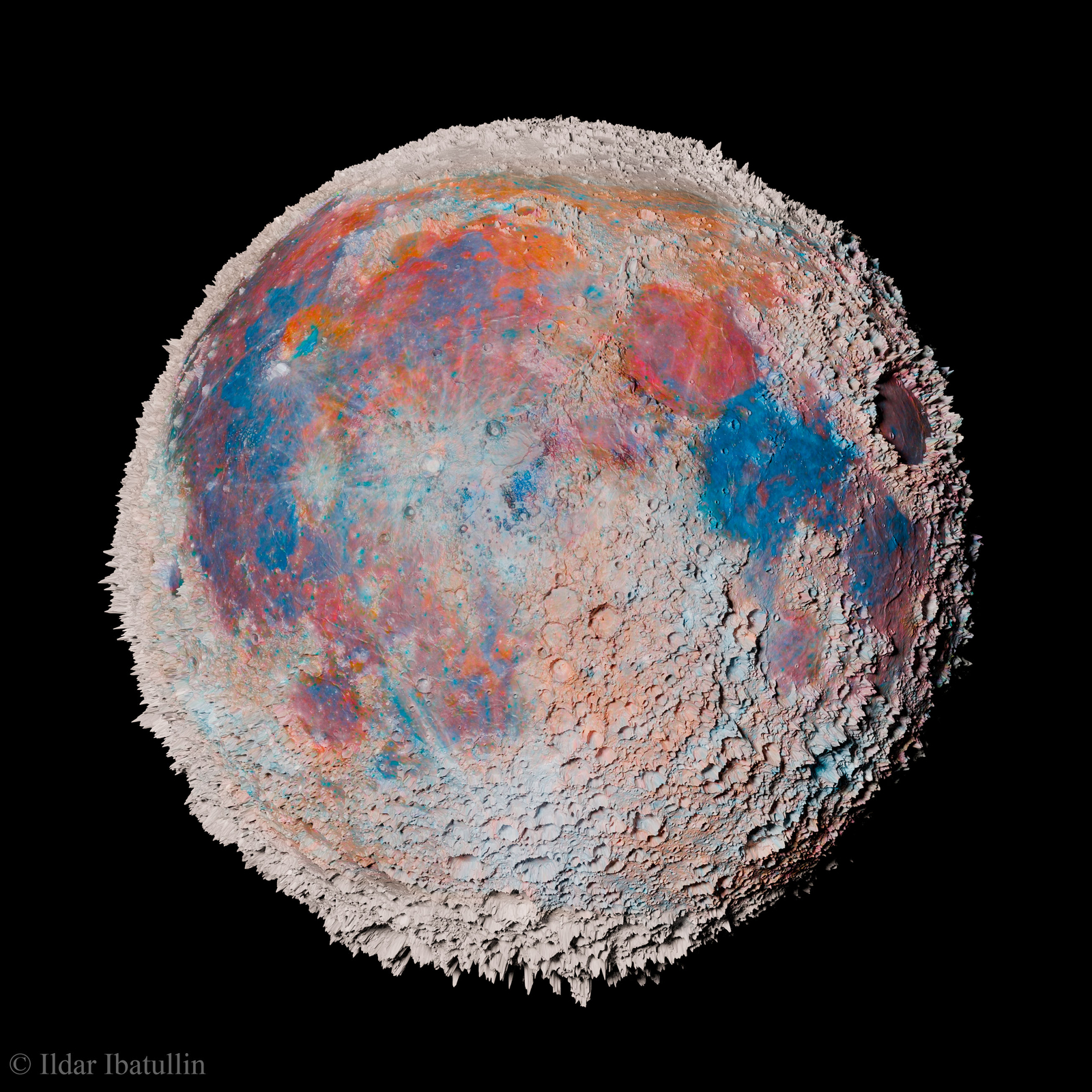
Our Moon doesn't really have craters this big. Earth's Moon , Luna, also doesn't naturally show this spikey texture, and its colors are more subtle. But this digital creation is based on reality. The featured image is a digital composite of a good Moon image and surface height data taken from NASA's Lunar Orbiter Laser Altimeter (LOLA) mission -- and then exaggerated for educational understanding . The digital enhancements, for example, accentuate lunar highlands and show more clearly craters that illustrate the tremendous bombardment our Moon has been through during its 4.6-billion-year history . The dark areas , called maria , have fewer craters and were once seas of molten lava . Additionally, the image colors , although based on the moon's real composition, are changed and exaggerated. Here, a blue hue indicates a region that is iron rich , while orange indicates a slight excess of aluminum . Although the Moon has shown the same side to the Earth for billions of years, modern technology is allowing humanity to learn much more about it -- and how it affects the Earth .
Media Credits & Attribution
Credit: Data: NASA , Lunar Orbiter Laser Altimeter ; Image & Processing: Ildar Ibatullin