
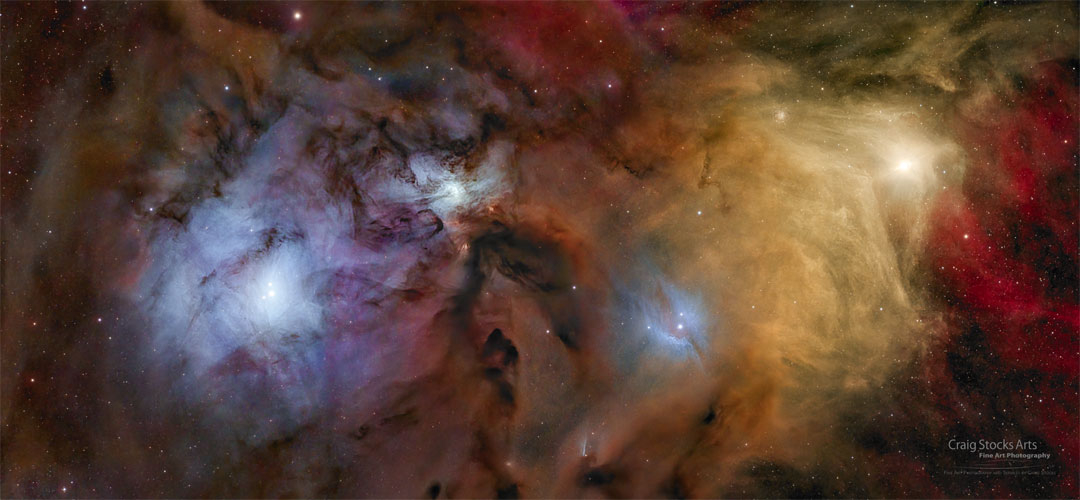
Why is the sky near Antares and Rho Ophiuchi so colorful, yet dusty? The colors result from a mixture of objects and processes. Fine dust -- illuminated by starlight -- produces blue reflection nebulae . Gaseous clouds whose atoms are excited by ultraviolet starlight produce reddish emission nebulae . Backlit dust clouds block starlight and so appear dark . Antares , a red supergiant and one of the brighter stars in the night sky , lights up the yellow-red clouds on the upper right of the featured image. The Rho Ophiuchi star system lies at the center of the blue reflection nebula on the left, while a different reflection nebula, IC 4605 , lies just below and right of the image center. These star clouds are even more colorful than humans can see, emitting light across the electromagnetic spectrum .
Open Science: Browse 3,400+ codes in the Astrophysics Source Code Library
Media Credits & Attribution
Image Credit & Copyright: Craig Stocks