
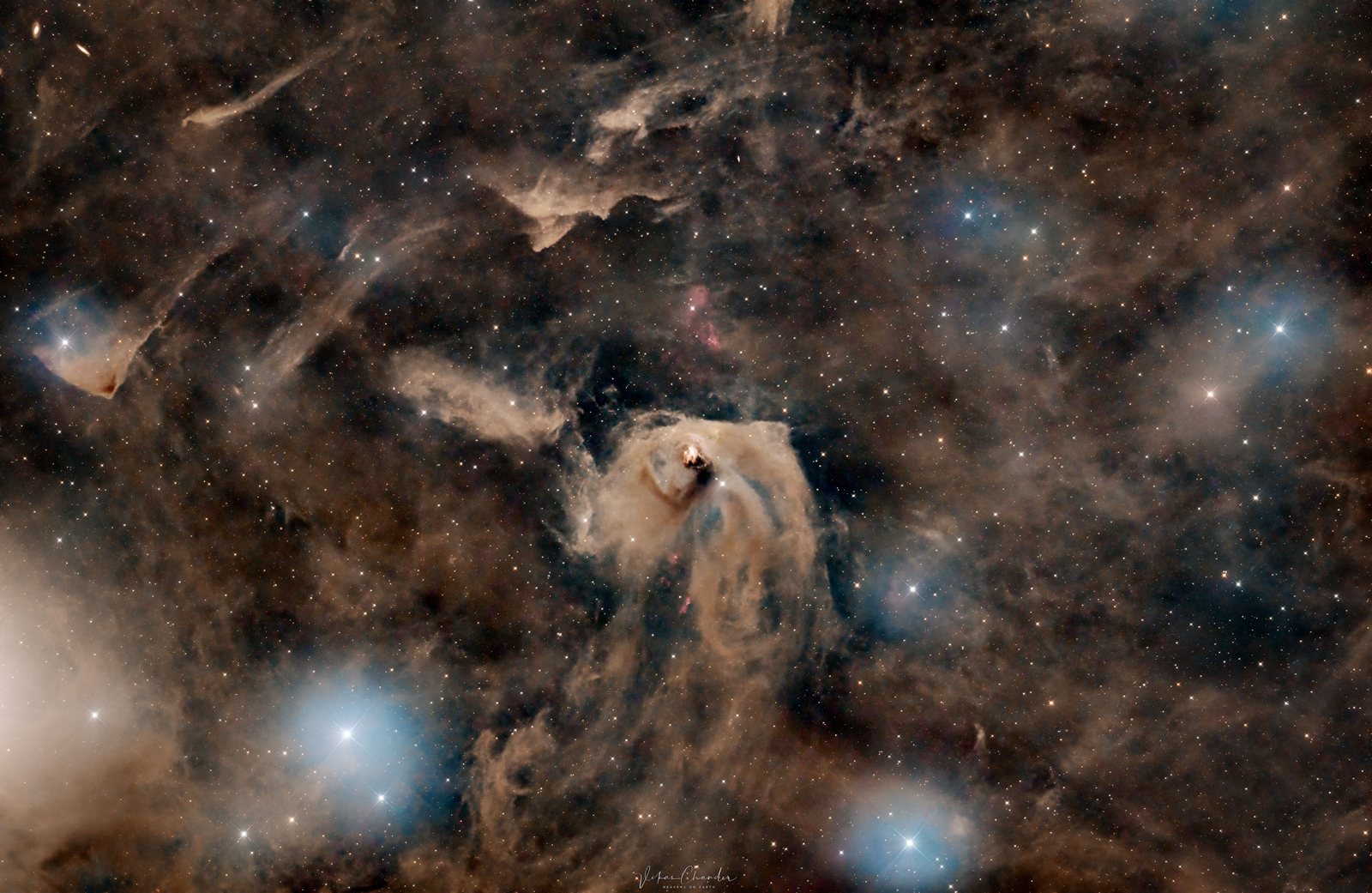
Can dust be beautiful? Yes, and it can also be useful. The Taurus molecular cloud has several bright stars, but it is the dark dust that really draws attention . The pervasive dust has waves and ripples and makes picturesque dust bunnies , but perhaps more importantly, it marks regions where interstellar gas is dense enough to gravitationally contract to form stars. In the image center is a light cloud lit by neighboring stars that is home not only to a famous nebula, but to a very young and massive famous star. Both the star, T Tauri , and the nebula, Hind's Variable Nebula , are seen to vary dramatically in brightness -- but not necessarily at the same time, adding to the mystery of this intriguing region. T Tauri and similar stars are now generally recognized to be Sun -like stars that are less than a few million years old and so still in the early stages of formation . The featured image spans about four degrees not far from the Pleiades star cluster, while the featured dust field lies about 400 light-years away.
Media Credits & Attribution
Image Credit & Copyright: Vikas Chander