
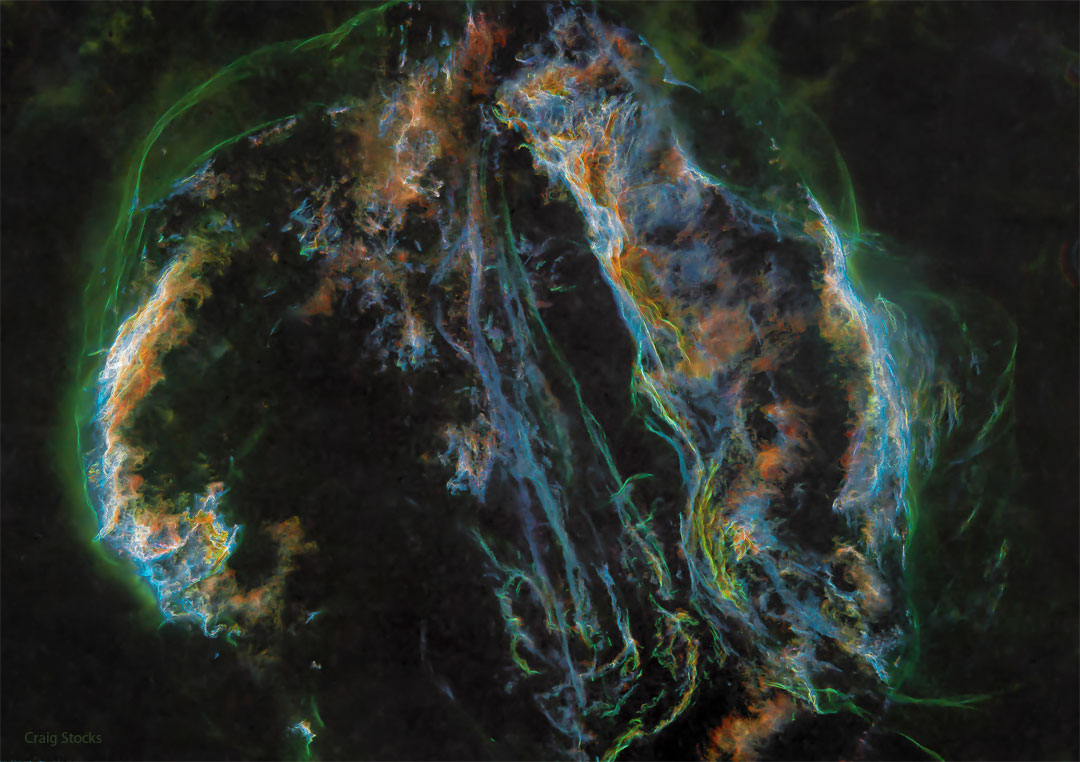
Ten thousand years ago, before the dawn of recorded human history , a new light would have suddenly have appeared in the night sky and faded after a few weeks. Today we know this light was from a supernova, or exploding star , and record the expanding debris cloud as the Veil Nebula , a supernova remnant . Imaged with color filters featuring light emitted by sulfur (red), hydrogen (green), and oxygen (blue), this deep wide-angle view was processed to remove the stars and so better capture the impressive glowing filaments of the Veil. Also known as the Cygnus Loop , the Veil Nebula is roughly circular in shape and covers nearly 3 degrees on the sky toward the constellation of the Swan (Cygnus). Famous nebular sections include the Bat Nebula , the Witch's Broom Nebula , and Fleming's Triangular Wisp . The complete supernova remnant lies about 1,400 light-years away.
Media Credits & Attribution
Image Credit & Copyright: Craig Stocks (Utah Desert Remote Observatories)