
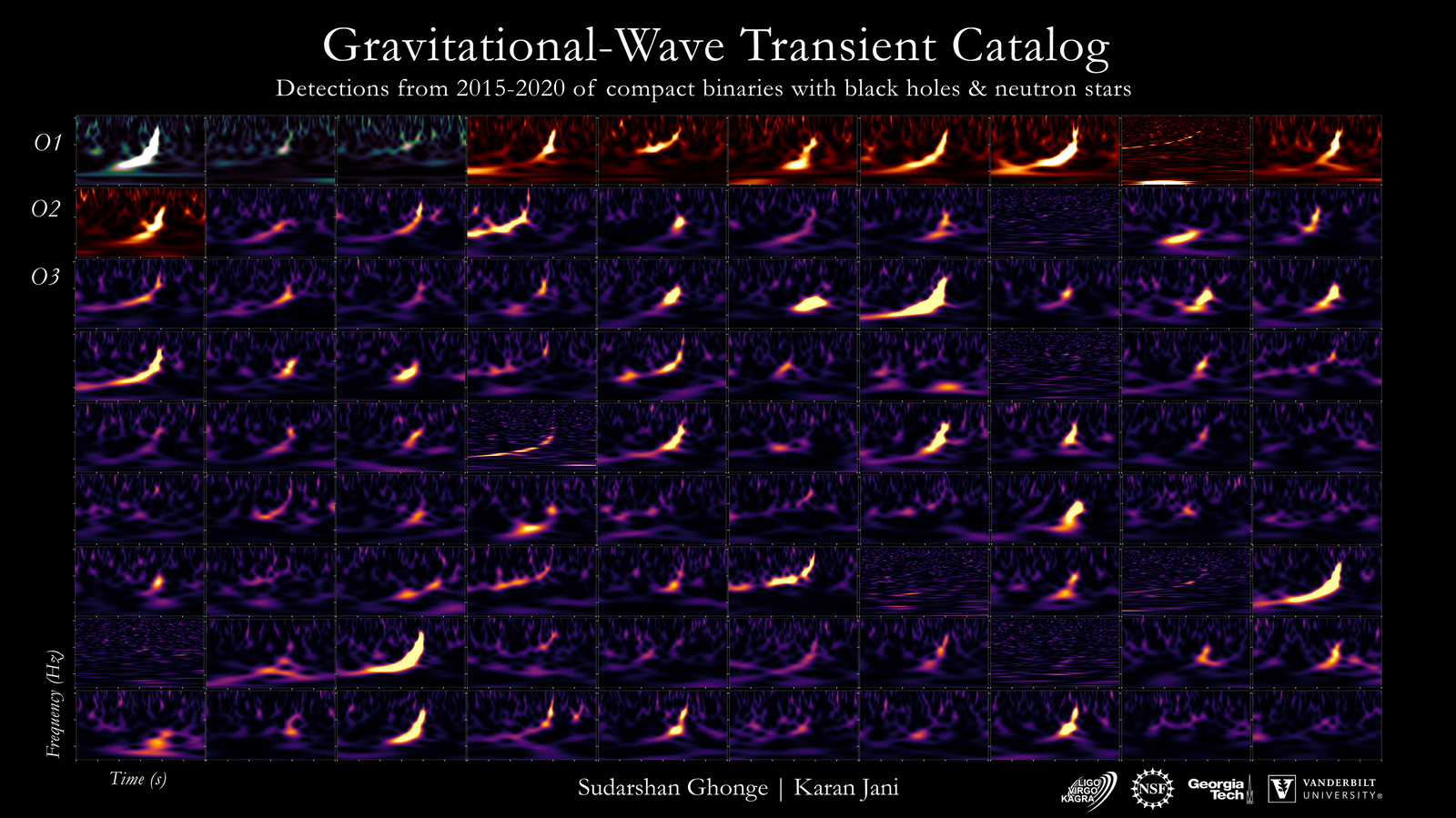
Every time two massive black holes collide , a loud chirping sound is broadcast out into the universe in gravitational waves . Humanity has only had the technology to hear these unusual chirps for the past seven years, but since then we have heard about 90 -- during the first three observing runs. Featured above are the spectrograms -- plots of gravitational-wave frequency versus time -- of these 90 as detected by the giant detectors of LIGO (in the USA ), VIRGO (in Europe ), and KAGRA (in Japan ). The more energy received on Earth from a collision, the brighter it appears on the graphic. Among many science firsts , these gravitational-radiation chirps are giving humanity an unprecedented inventory of black holes and neutron stars , and a new way to measure the expansion rate of our universe. A fourth gravitational wave observing run with increased sensitivity is currently planned to begin in 2022 December.
Media Credits & Attribution
Image Credit: NSF , LIGO , VIRGO , KAGRA , Georgia Tech , Vanderbilt U. ; Graphic : Sudarshan Ghonge & Karan Jani