
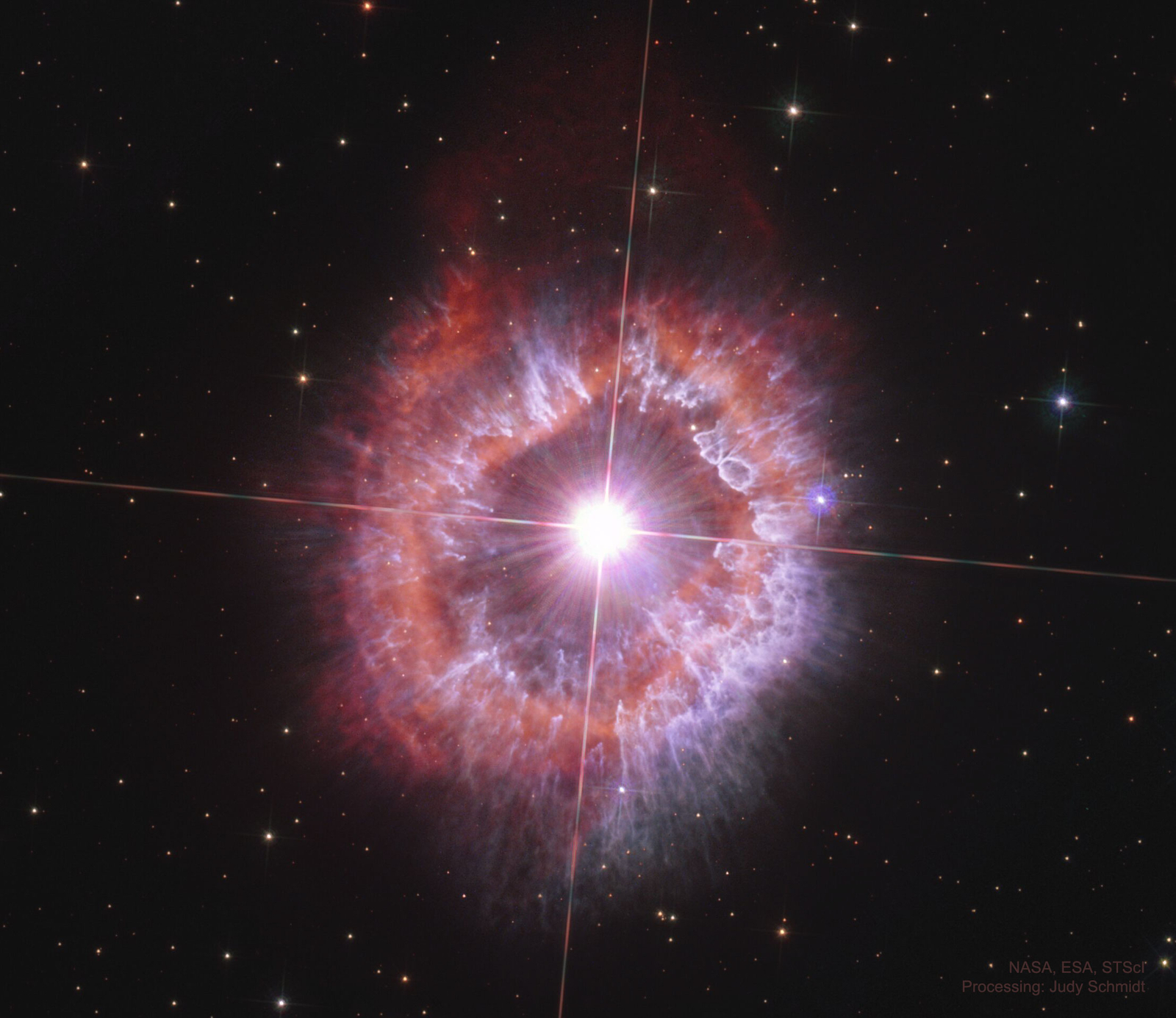
What created these unusual clouds? At the center of this 2021 Hubble image , processed by Judy Schmidt, sits AG Carinae , a supergiant star located about 20,000 light-years away in the southern constellation Carina . The star's emitted power is over a million times that of the Sun, making AG Carinae one of the most luminous stars in our Milky Way galaxy . AG Carinae and its neighbor Eta Carinae belong to the scarce Luminous Blue Variable (LBV) class of stars, known for their rare but violent eruptions . The nebula that surrounds AG Car is interpreted as a remnant of one or more such outburst s. This nebula measures 5 light-years across, is estimated to contain about 10 solar masses of gas, and to be at least 10,000 years old. This Hubble image , taken to commemorate Hubble's 31st launch anniversary , is the first to capture the whole nebula, offering a new perspective on its structure and dust content. The LBVs represent a late and short stage in the lives of some supergiant stars , but explaining their restlessness remains a challenge to humanity's understanding of how massive stars work .
Media Credits & Attribution
Image Credit: NASA , ESA , STScI ; Processing: Judy Schmidt ; Text: Anders Nyholm