
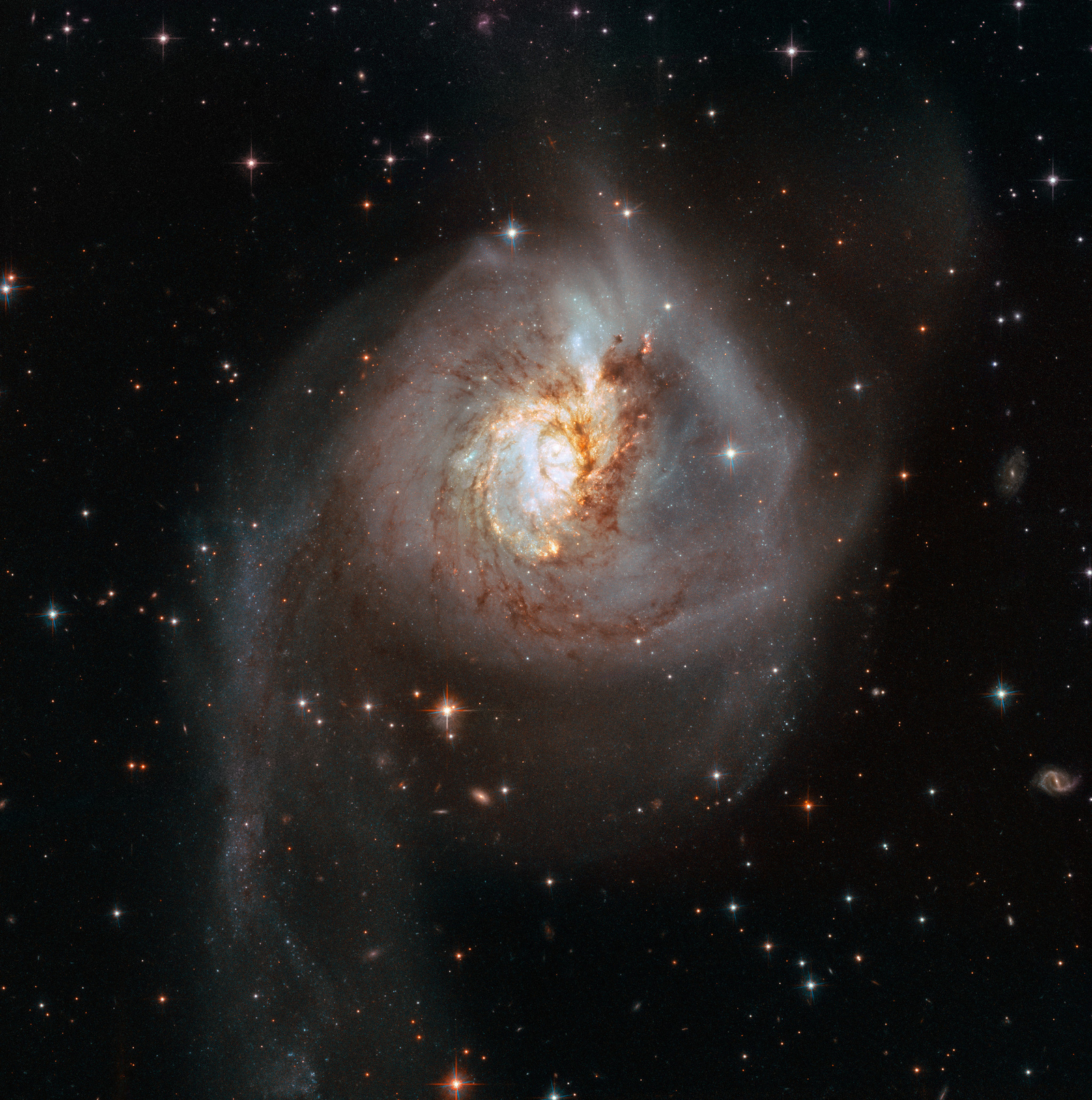
Marked by an unusually bright central region, swirling dust lanes, and far flung tidal tails, peculiar NGC 3256 is the aftermath of a truly cosmic collision . The 500 million year old clash of two separate galaxies spans some 100 thousand light-years in this sharp Hubble view . Of course when two galaxies collide, individual stars rarely do. Giant galactic clouds of molecular gas and dust do interact though, and produce spectacular bursts of star formation . In this galaxy clash , the two original spiral galaxies had similar masses. Their disks are no longer distinct and the two galactic nuclei are hidden by obscuring dust. On the timescale of a few hundred million years the nuclei will likely also merge as NGC 3256 becomes a single large elliptical galaxy. NGC 3256 itself is nearly 100 million light-years distant toward the southern sailing constellation Vela. The frame includes many even more distant background galaxies and spiky foreground stars.
Media Credits & Attribution
Image Credit & License: NASA , ESA , Hubble Space Telescope