
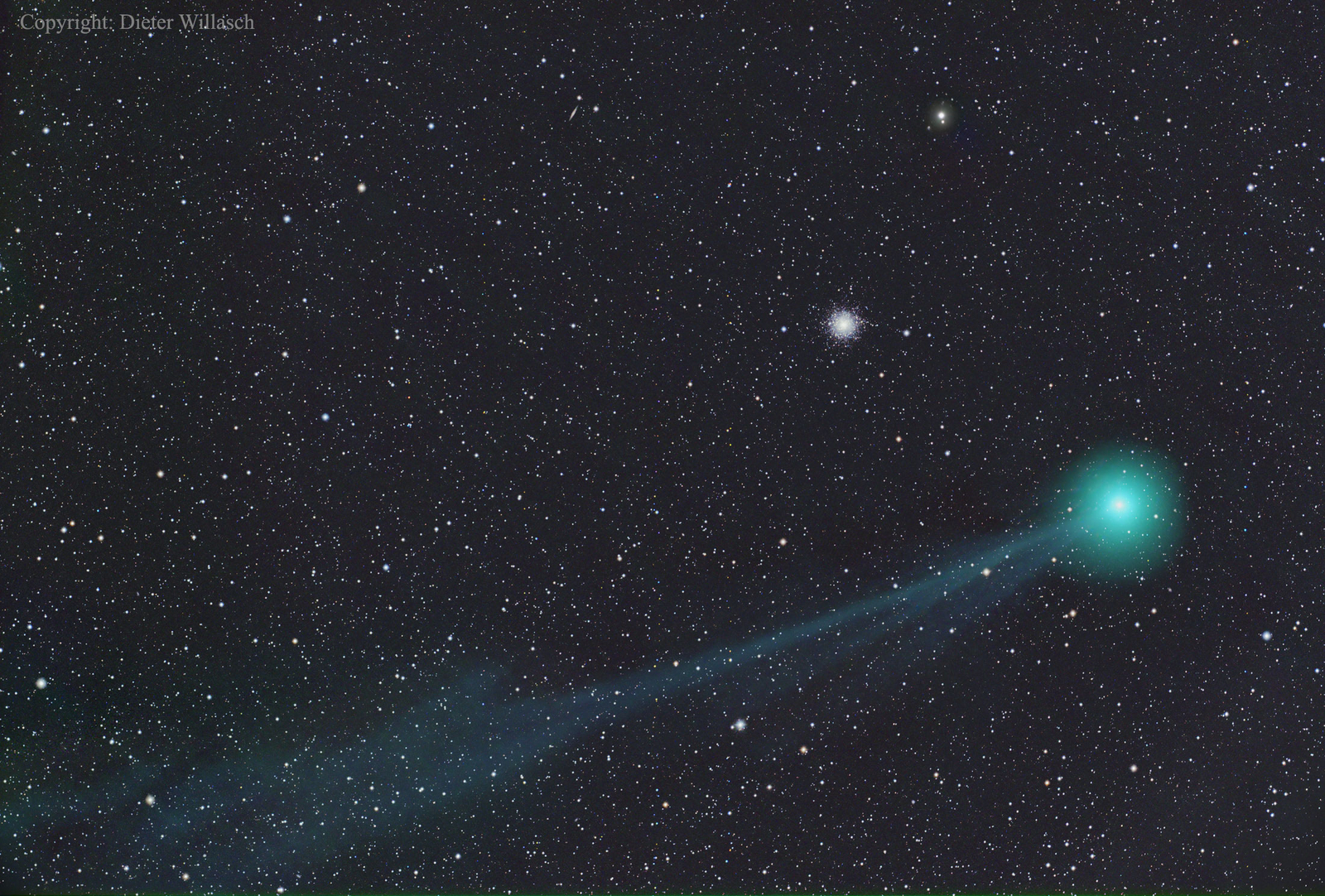
Comet Lovejoy has become visible to the unaided eye. To see the comet, just go outside an hour or so after sunset and look for a fuzzy patch to the right of Orion's belt . Binoculars and a star chart may help. Pictured here , Comet C/2014 Q2 (Lovejoy) was captured three days ago passing nearly in front of M79 , the globular star cluster visible as the bright spot slightly above and to the left of the comet's green-hued coma. The nucleus of Comet Lovejoy is a giant dirty iceberg that is shedding gas into a long and intricate ion tail , extending across the image , as it nears the Sun. The comet is expected to become even easier to spot for northern observers during January, as it is rises earlier and, hopefully, continues to brighten.
Media Credits & Attribution
Image Credit & Copyright: Dieter Willasch ( Astro-Cabinet )