
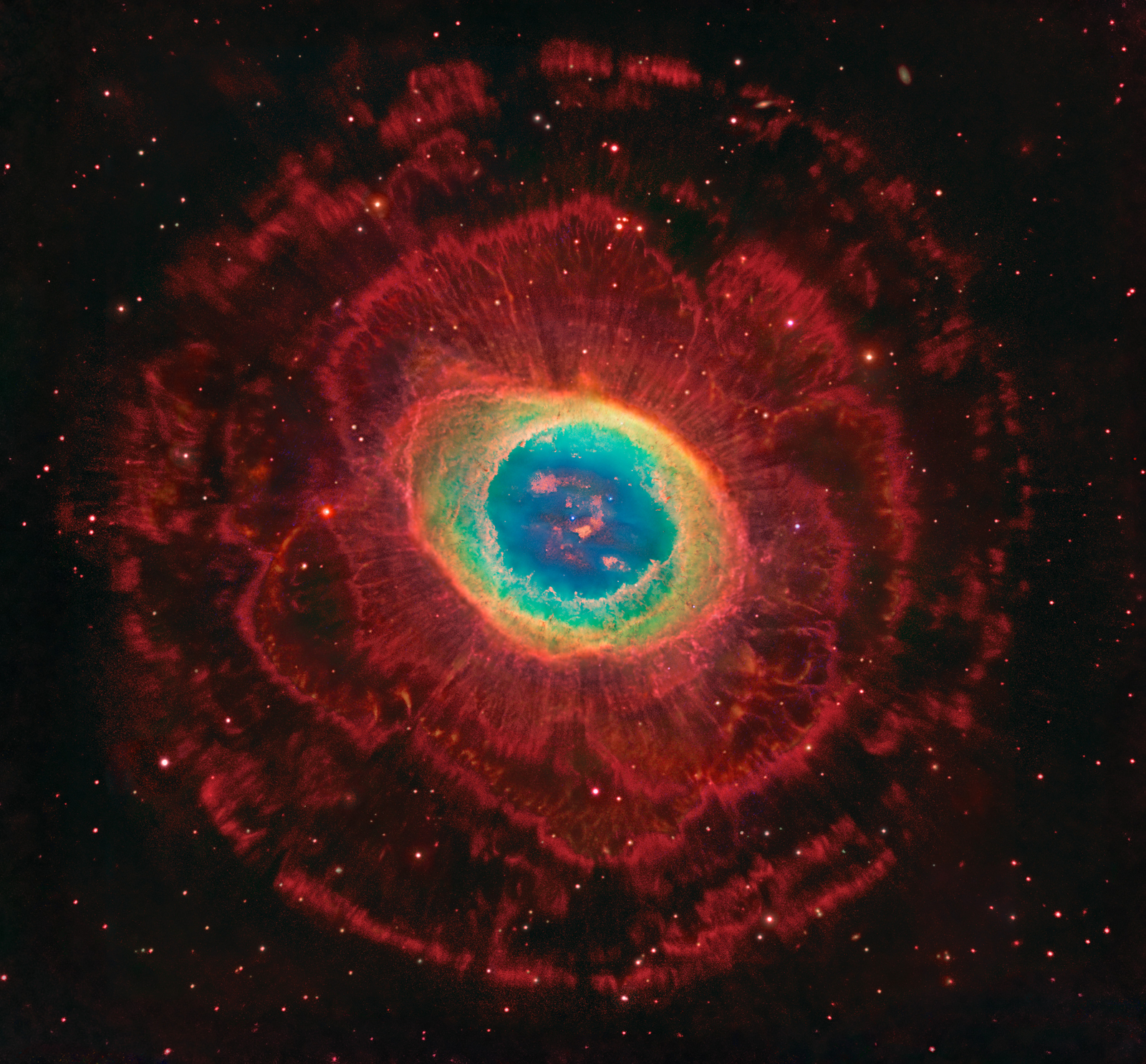
It is a familiar sight to sky enthusiasts with even a small telescope. There is much more to the Ring Nebula (M57) , however, than can be seen through a small telescope . The easily visible central ring is about one light-year across, but this remarkably deep exposure - a collaborative effort combining data from three different large telescopes - explores the looping filaments of glowing gas extending much farther from the nebula's central star . This remarkable composite image includes narrowband hydrogen image, visible light emission, and infrared light emission. Of course, in this well-studied example of a planetary nebula , the glowing material does not come from planets. Instead, the gaseous shroud represents outer layers expelled from a dying, sun-like star. The Ring Nebula is about 2,000 light-years away toward the musical constellation Lyra .
Follow APOD on: Facebook , Google Plus , or Twitter
Media Credits & Attribution
Image Credit: Hubble , Large Binocular Telescope , Subaru Telescope ; Composition & Copyright: Robert Gendler