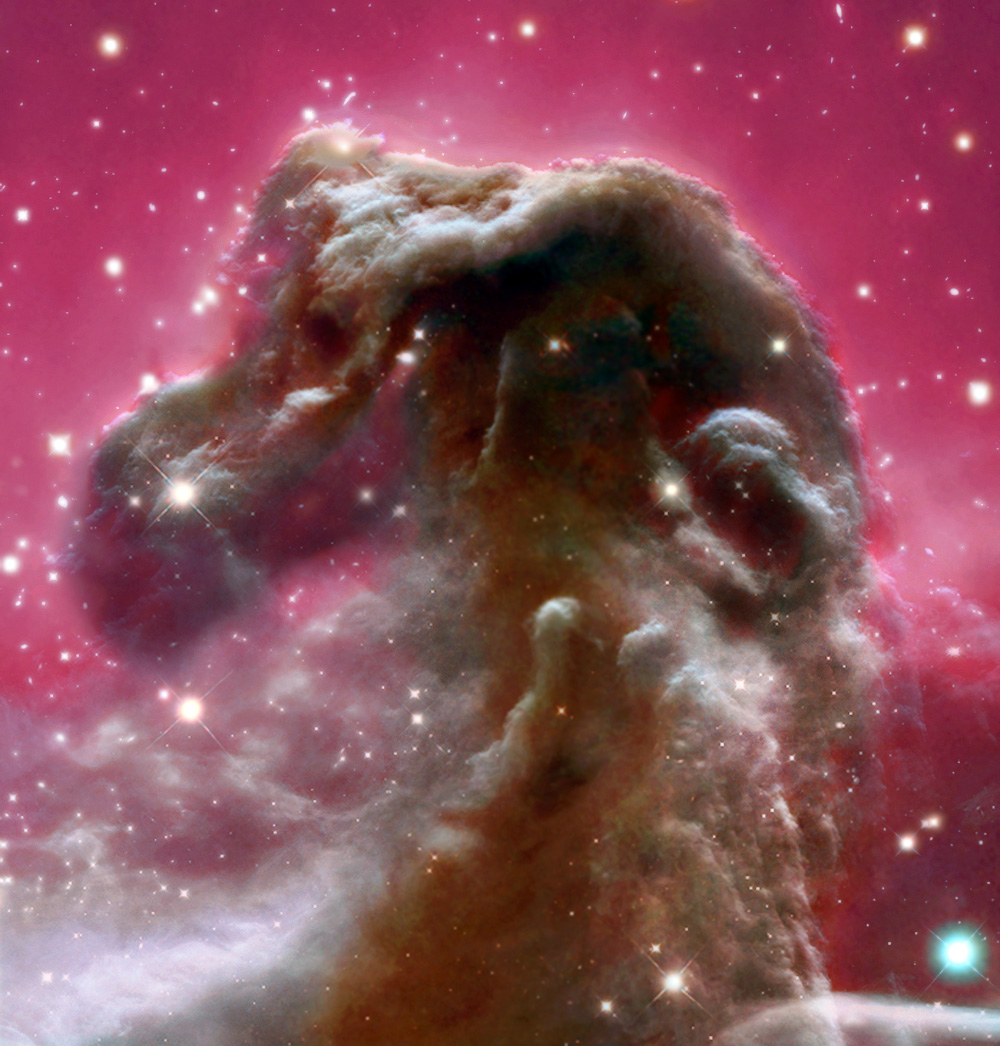
One of the most identifiable nebulae in the sky, the Horsehead Nebula in Orion , is part of a large, dark, molecular cloud . Also known as Barnard 33, the unusual shape was first discovered on a photographic plate in the late 1800s. The red glow originates from hydrogen gas predominantly behind the nebula, ionized by the nearby bright star Sigma Orionis . The darkness of the Horsehead is caused mostly by thick dust , although the lower part of the Horsehead 's neck casts a shadow to the left. Streams of gas leaving the nebula are funneled by a strong magnetic field . Bright spots in the Horsehead Nebula 's base are young stars just in the process of forming . Light takes about 1,500 years to reach us from the Horsehead Nebula . The above image is a digital combination of images taken in blue, green, red, and hydrogen-alpha light from the Argentina , and an image taken in infrared light by the orbiting Hubble Space Telescope .
Follow APOD on: Facebook , Google Plus , or Twitter
Media Credits & Attribution
Image Credit & Copyright: Optical: [Aldo Mottino](mailto:amottino at unr dot edu dot ar) & Carlos Colazo, OAC, Crdoba ; Infrared: Hubble Legacy Archive