
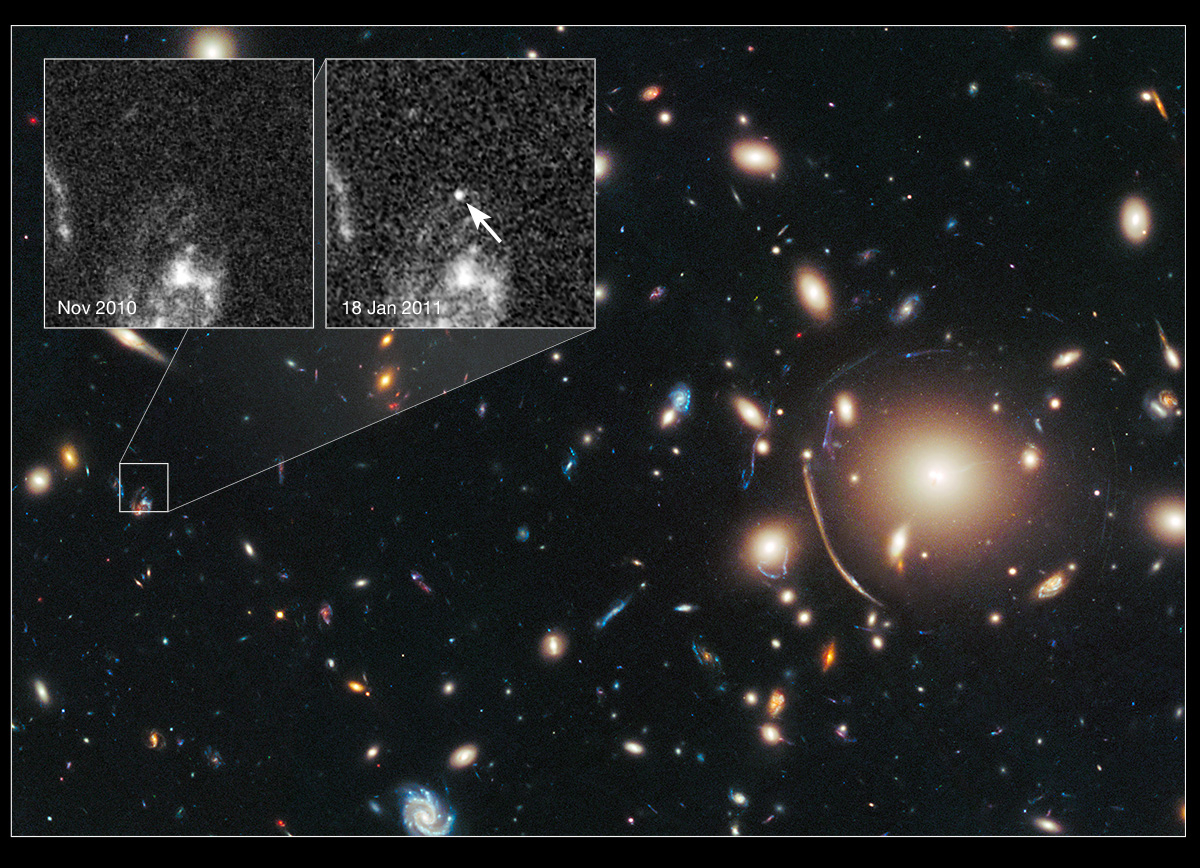
How do you calibrate a huge gravitational lens? In this case the lens is the galaxy cluster Abell 383 , a massive conglomeration of galaxies, hot gas, and dark matter that lies about 2.5 billion light years away ( redshift z=0.187). What needs calibrating is the mass of the cluster, in particular the amount and distribution of dark matter. A new calibration technique has been tested recently that consists of waiting for supernovas of a very specific type to occur behind a galaxy cluster, and then figuring out how much the cluster must have magnified these supernovas through gravitational lensing. This technique compl e ments other measures including computing the dark matter needed to contain internal galaxy motions , to confine cluster hot gas , and to create the gravitational lens image distortions. Pictured above from the Hubble Space Telescope , galaxy cluster A383 shows its gravitational lens capabilities on the right by highly distorting background galaxies behind the cluster center. On the left is a distant galaxy shown both before and after a recent revealing supernova. To date, calibration-quality supernovas of Type Ia have been found behind two other galaxy clusters by the Cluster Lensing And Supernova survey with Hubble ( CLASH ) project.
Follow APOD on: Facebook , Google Plus , or Twitter
Media Credits & Attribution
Image Credit: NASA , ESA , C. McCully ( Rutgers U. ) et al.