
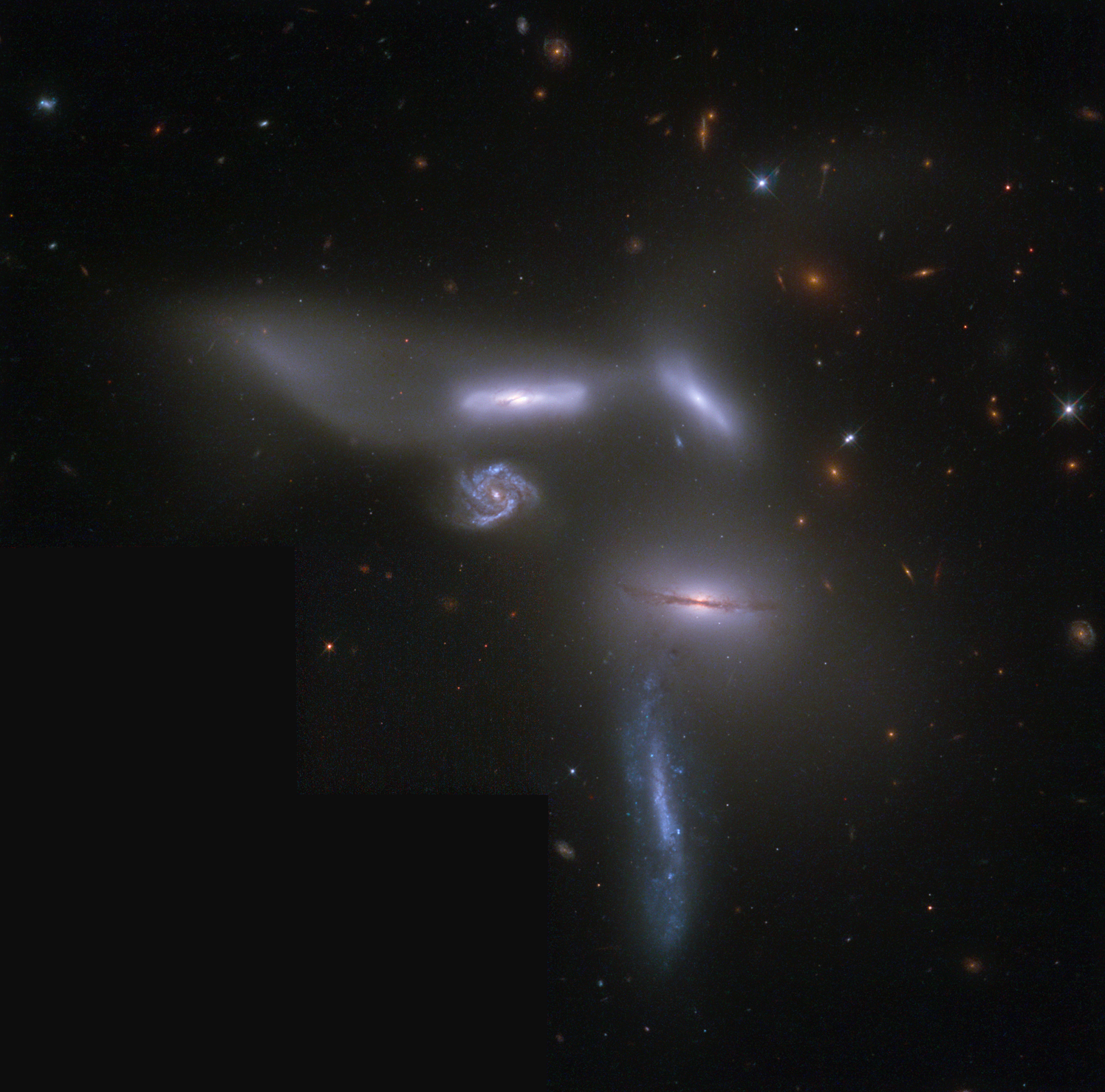
What will survive this battle of the galaxies? Known as Seyfert's Sextet , this intriguing group of galaxies lies in the head portion of the split constellation of the Snake ( Serpens ). The sextet actually contains only four interacting galaxies, though. Near the center of this Hubble Space Telescope picture , the small face-on spiral galaxy lies in the distant background and appears only by chance aligned with the main group. Also, the prominent condensation on the upper left is likely not a separate galaxy at all, but a tidal tail of stars flung out by the galaxies' gravitational interactions. About 190 million light-years away, the interacting galaxies are tightly packed into a region around 100,000 light-years across, comparable to the size of our own Milky Way galaxy , making this one of the densest known galaxy groups . Bound by gravity, the close-knit group may coalesce into a single large galaxy over the next few billion years.
Free lecture: APOD editor to speak in NYC on Jan. 3
Media Credits & Attribution
Image Credit: Hubble Legacy Archive , NASA , ESA ; Processing: Judy Schmidt