
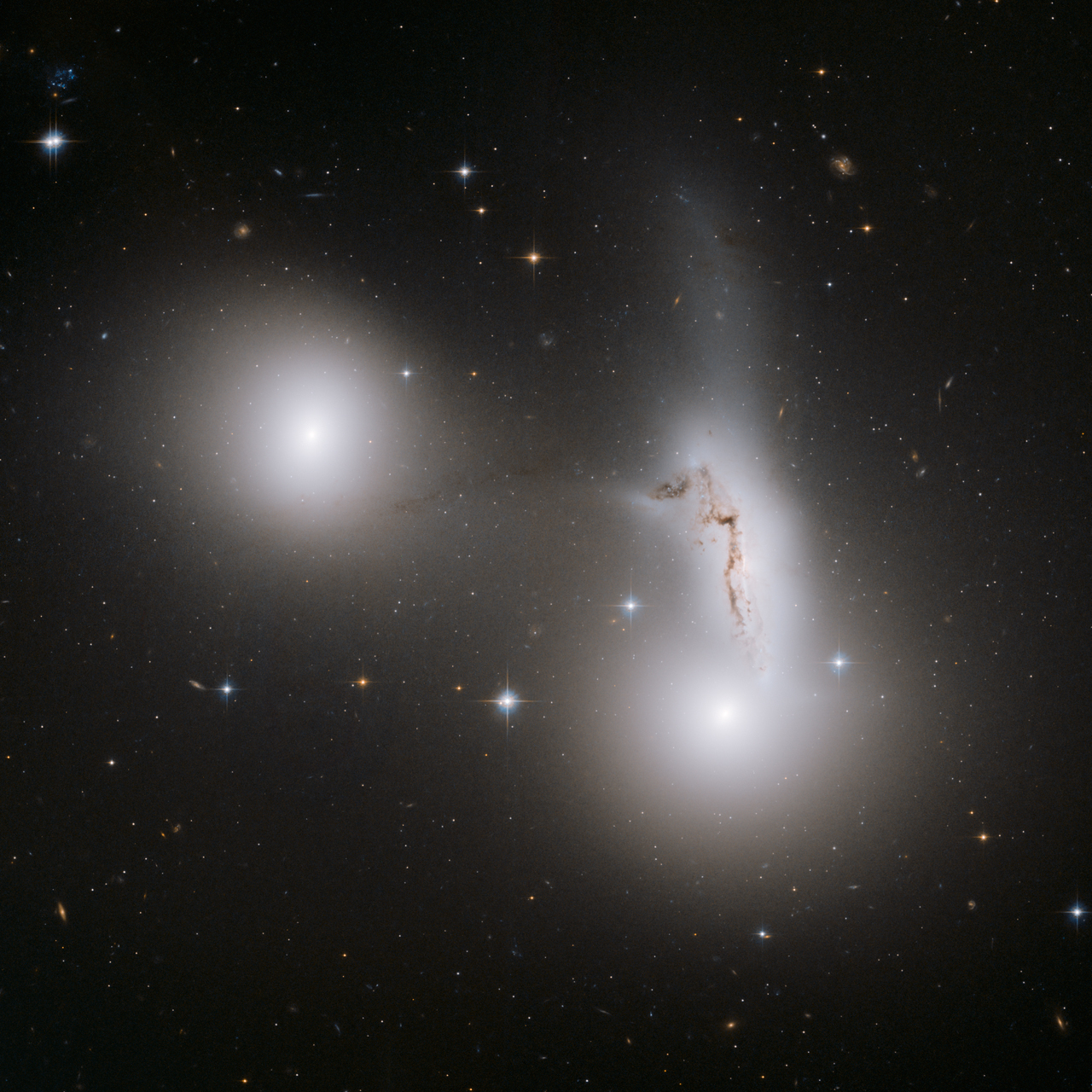
Scanning the skies for galaxies, Canadian astronomer Paul Hickson and colleagues identified some 100 compact groups of galaxies , now appropriately called Hickson Compact Groups (HCGs). This sharp Hubble image shows one such galaxy group , HCG 90, in startling detail. Three galaxies are revealed to be strongly interacting: a dusty spiral galaxy stretched and distorted between a pair of large elliptical galaxies. The close encounter will trigger furious star formation . On a cosmic timescale, the gravitational tug of war will eventually result in the merger of the trio into a large single galaxy. The merger process is now understood to be a normal part of the evolution of galaxies, including our own Milky Way . HCG 90 lies about 100 million light-years away in the constellation Piscis Austrinus . This Hubble view spans about 80,000 light-years at that estimated distance. Of course, Hickson Compact Groups also make for rewarding viewing for Earth-bound astronomers with more modest sized telescopes.
Media Credits & Attribution
Credit: NASA , ESA , R. Sharples ( Univ. Durham )