
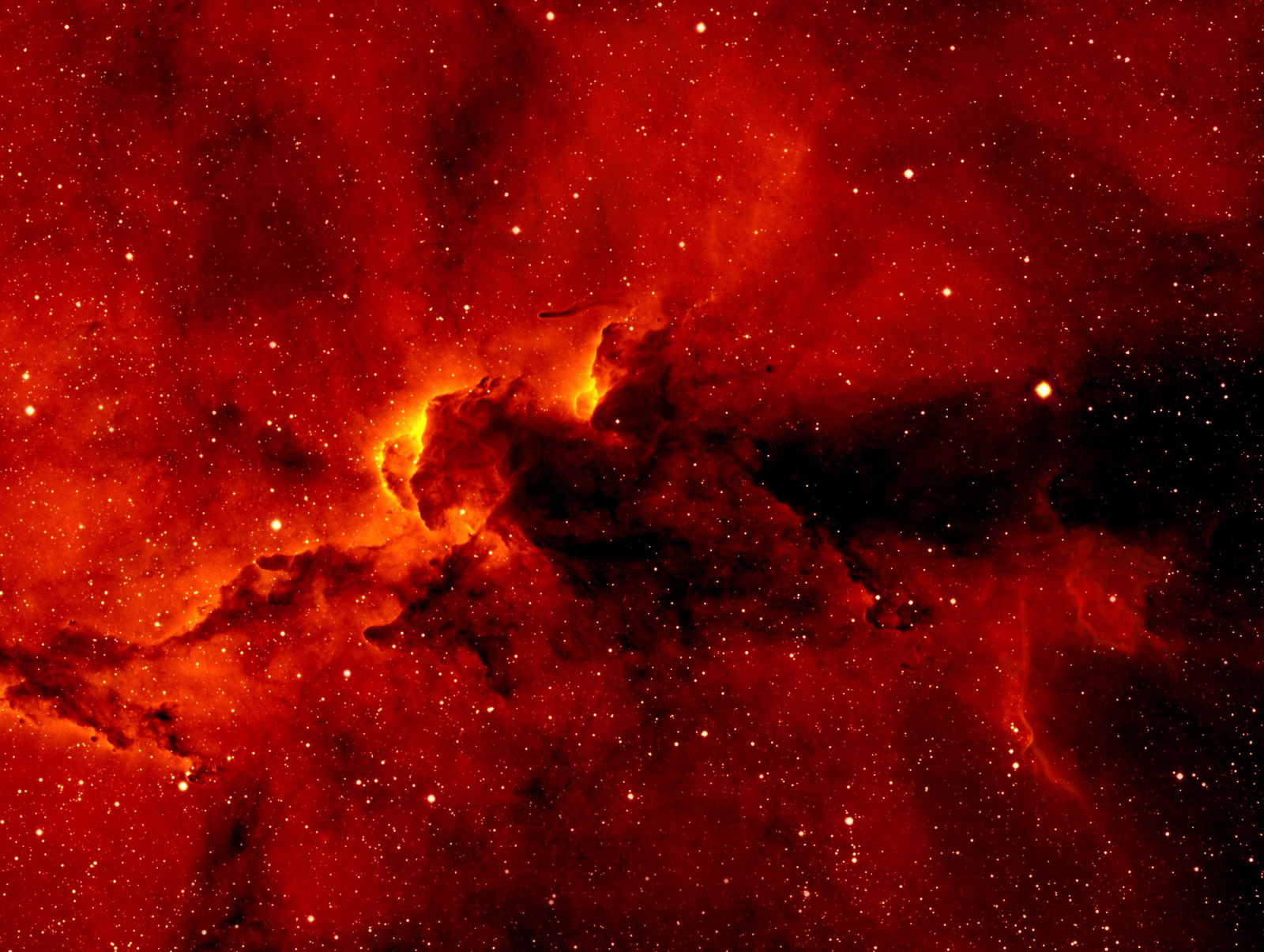
Clouds of glowing hydrogen gas mingle ominously with dark dust lanes in this close-up of IC 1396 , an active star forming region some 2,000 light years away in the constellation Cepheus. In this and other similar emission nebulae , energetic ultraviolet light from a hot young star strips electrons from the surrounding hydrogen atoms. As the electrons and atoms recombine they emit longer wavelength, lower energy light in a well known characteristic pattern of bright spectral lines . At visible wavelengths, the strongest emission line in this pattern is in the red part of the spectrum and is known as “Hydrogen-alpha” or just H-alpha . Part of IPHAS , a survey of H-alpha emission in our Milky Way Galaxy, this image spans about 20 light-years and highlights bright, dense regions within IC 1396, likely sites where massive new stars are born.
Media Credits & Attribution
Credit: Nick Wright ( University College London ), IPHAS Collaboration