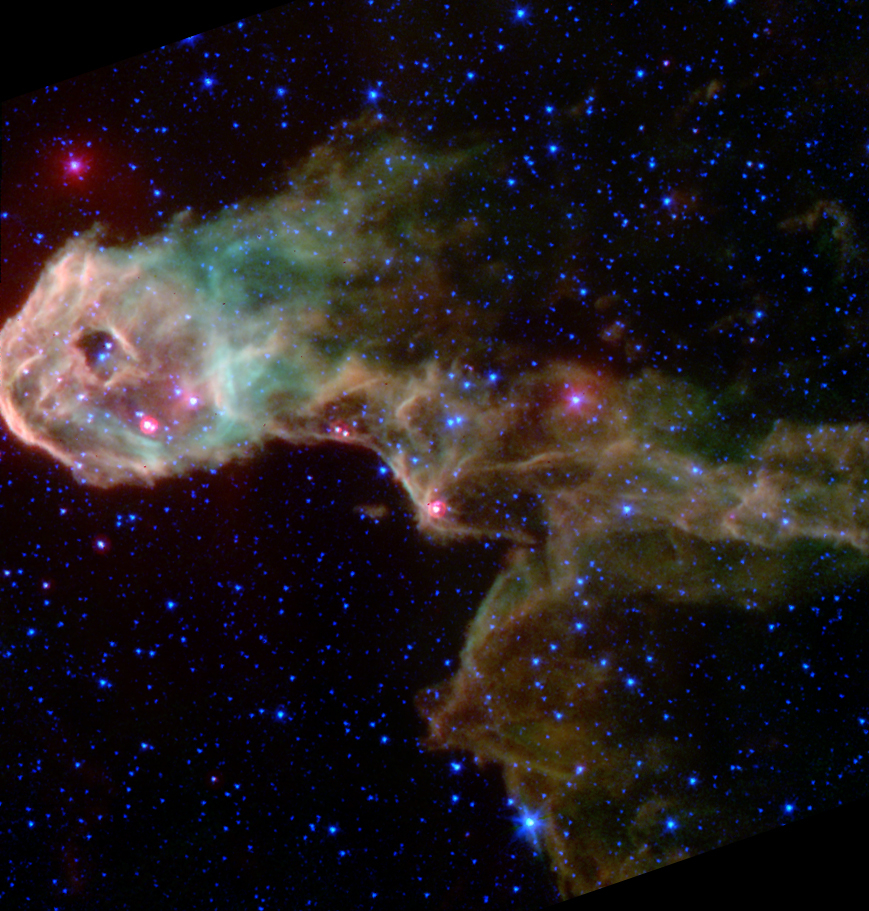
In December of 2003, the world saw spectacular first images from the Spitzer Space Telescope , including this penetrating interior view of an otherwise opaque dark globule known as the Elephant's Trunk Nebula . Seen in a composite of infrared image data recorded by Spitzer's instruments, the intriguing region is embedded within the glowing emission nebula IC 1396 at a distance of 2,450 light-years toward the constellation Cepheus. Previously undiscovered protostars hidden by dust at optical wavelengths appear as bright reddish objects within the globule. Shown in false-color , winding filaments of infrared emission span about 12 light-years and are due to dust, molecular hydrogen gas, and complex molecules called polycyclic aromatic hydrocarbons or PAHs . The Spitzer Space Telescope was formerly known as the Space Infrared Telescope Facility ( SIRTF ) and is presently exploring the Universe at infrared wavelengths. Spitzer follows the Hubble Space Telescope, the Compton Gamma-ray Observatory, and the Chandra X-ray Observatory as the final element in NASA's space-borne Great Observatories Program .
9 April 2005
Inside the Elephant's Trunk