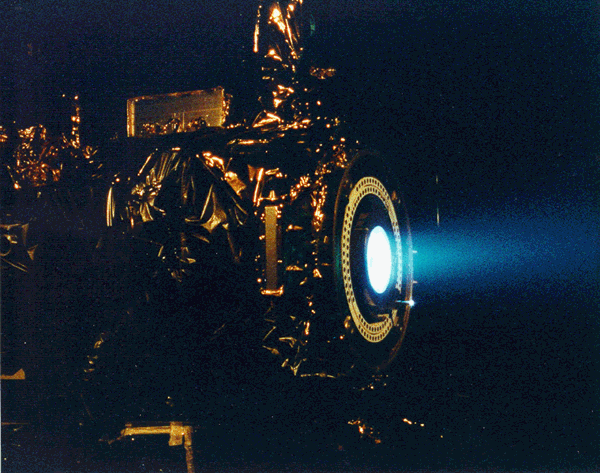
Space travel entered the age of the ion drive in 1998 with the launch of Deep Space 1 , a NASA mission designed primarily to test new technologies. Although the ion drive on Deep Space 1 provided acceleration much smaller than we feel toward Earth , it gradually gave the spacecraft the speed it needed to travel across our Solar System . The propulsion drive worked by ionizing xenon atoms with power provided by large panels that collect sunlight. As these ions were expelled by a strong electric field out the back, the spacecraft slowly gained speed. Pictured above , hot blue ions emerge from a prototype drive that was successfully tested at JPL in 1997. Deep Space 1 successfully zoomed past asteroid 9969 Braille in July 1999 and then Comet Borrelly in September 2001, then obtaining the most detailed photograph ever taken of a comet nucleus. The spacecraft was retired in December 2001
20 July 2003
An Ion Drive for Deep Space 1