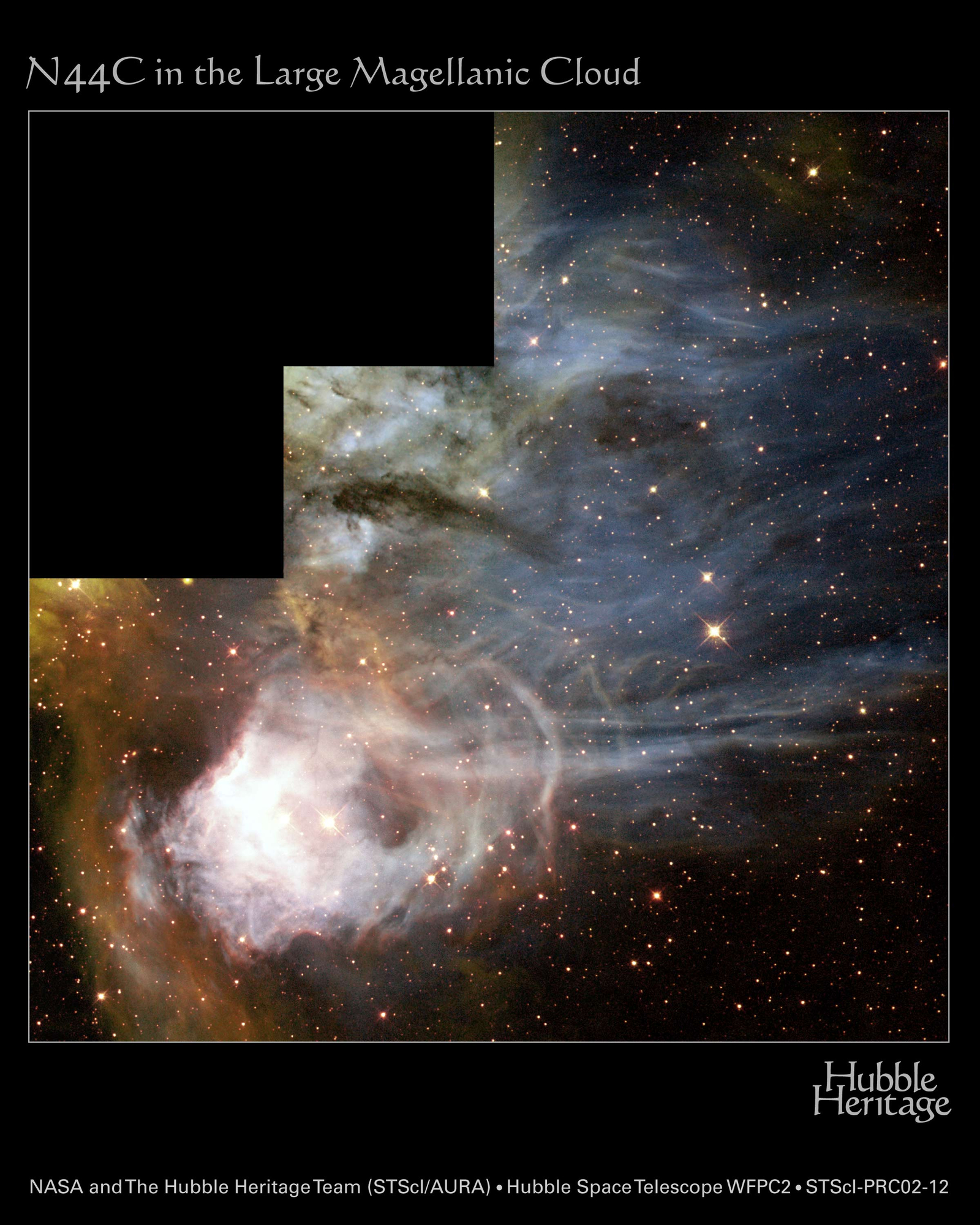
Why is N44C glowing so strangely? The star that appears to power the nebula, although young and bright, does not seem hot enough to create some of the colors observed. A search for a hidden hotter star in X-rays has come up empty. One hypothesis is that the known central star has a neutron star companion in a very wide orbit . Hot X-rays might only then be emitted during brief periods when the neutron star nears the known star and crashes through a disk of surrounding gas . Future observations might tell. N44C, pictured in the above Hubble Space Telescope image, is an emission nebula in the Large Magellanic Cloud , a neighboring galaxy to our Milky Way Galaxy . Flowing filaments of colorful gas and dark dust far from the brightest region are likely part of the greater N44 complex . It would take light about 125 years to cross N44C.
Media Credits & Attribution
Credit: Donald Garnett ( U. Arizona ) et al. , Hubble Heritage Team , NASA