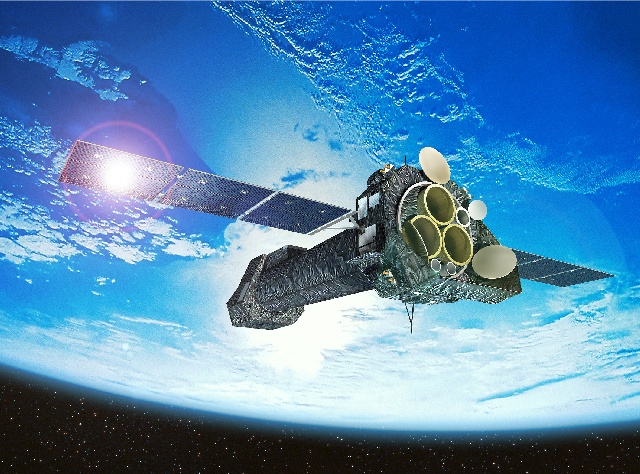
X-ray astronomy entered a golden age earlier this month with the successful launch of the X-ray Multi-Mirror (XMM) satellite. XMM 's three huge telescope barrels each hold 58 concentric cylindrical mirrors, together totaling a surface area rivaling a tennis court . Each mirror has been gold plated to less than one-millimeter thickness to reflect normally penetrating X-rays . ESA's XMM joins NASA's Chandra X-ray Observatory as leading observatories in X-ray astronomy. The XMM satellite also carries a small optical and ultraviolet telescope. XMM 's unusually elliptical orbit around the Earth peaks nearly one-third of the way to the Moon. XMM's observing program during its planned two-year mission includes monitoring the hot surroundings of black holes , the fiery regions surrounding the centers of galaxies , the mysterious X-ray background light that appears to come from all directions, and the hot gas that glows between galaxies and stars.
21 December 1999
XMM Launched