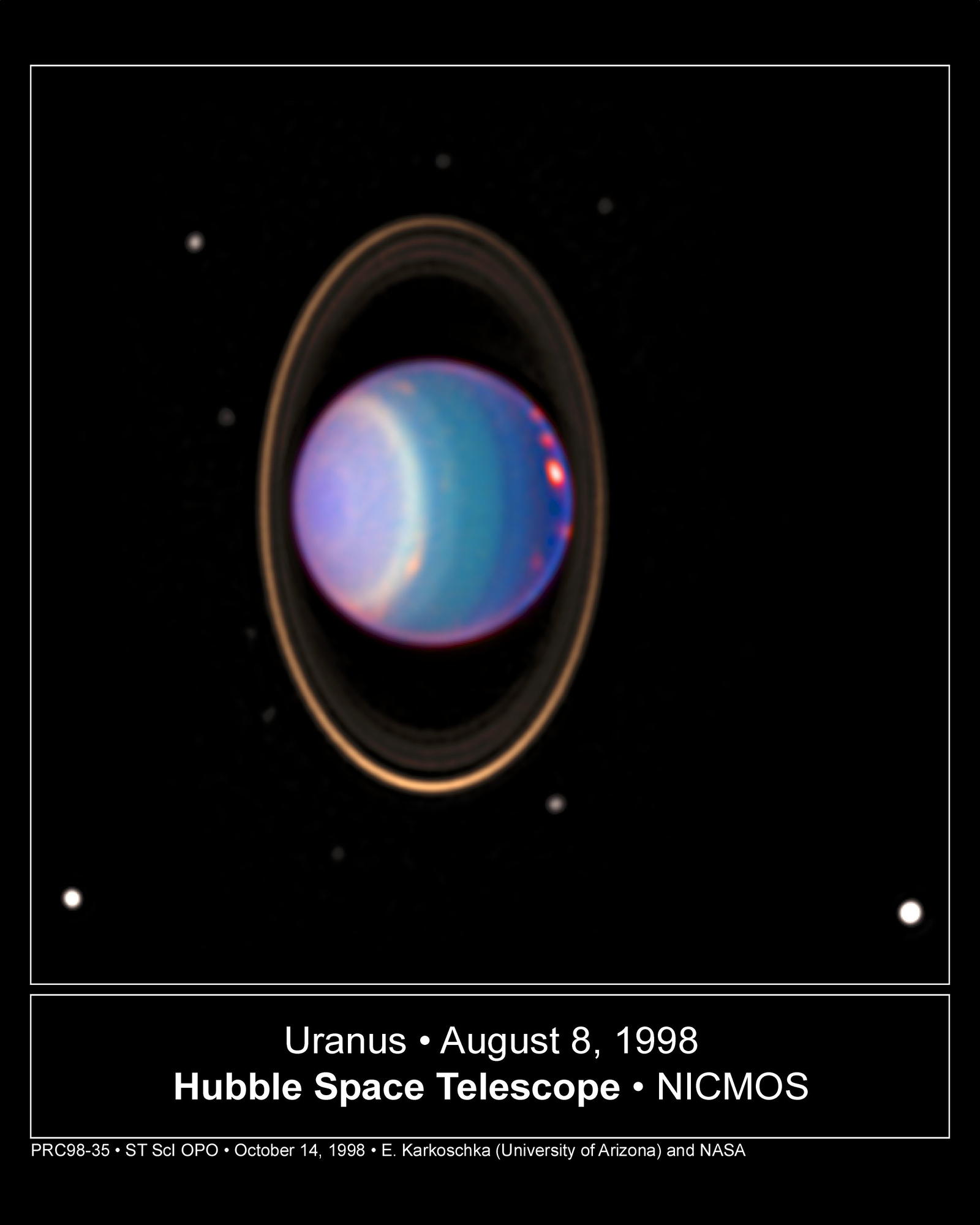
The Sun 's third largest planet usually looks quite dull. Uranus typically appears as a featureless small spot in a small telescope or a featureless large orb in a large telescope. Last August, however, the Hubble Space Telescope was able to photograph Uranus in infrared light, where the distant planet better shows its unusual clouds, rings, and moons . Recent analysis indicates that clouds seen here in orange appear to circle Uranus at speeds in excess of 500 kilometers per hour. Comparisons to earlier photographs show a slight precession shift in the brightest of Uranus' rings . Several of Uranus' numerous small moons are visible.
Media Credits & Attribution
Credit: E. Karkoschka et al. (University of Arizona), NICMOS, HST, NASA