
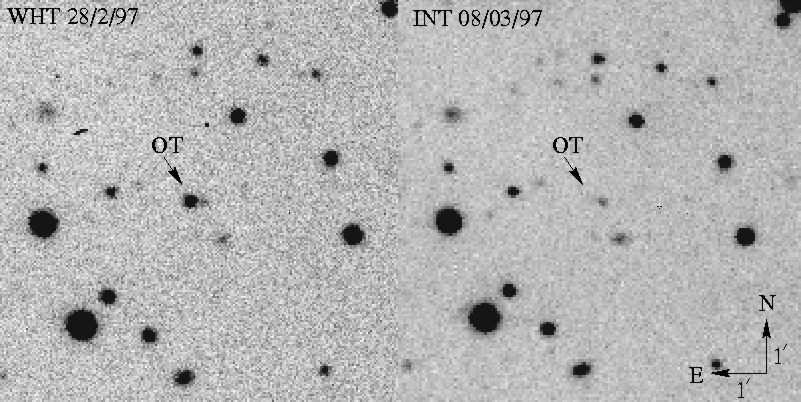
Explanation : The largest telescopes in the world have scrambled to point toward this faint, fading object. Why? Because it may well be the first active optical counterpart ever found for a gamma-ray burst , and could hold the clue to the distance scale to this most enigmatic class of astronomical objects . During the past two months, multiwavelength observations, claims , and counterclaims have been exchanged at a torrential pace, as astronomers wait impatiently to see what setting houses the fading transient . Above are two pictures of the optical transient (OT), one taken on February 28 th , the other about a week later on March 8 th . The OT arrows show the source that faded from view during this time. The OT has been examined by large telescopes including the Hubble Space Telescope and Keck , yet researchers are still scrambling to get answers to fundamental questions about its true nature. Does the OT actually move (exhibit proper motion )? Is there a faint galaxy superposed behind the OT or is this extended emission fading too? In the face of intense scrutiny with the world's most capable telescopes, the origin of gamma-ray bursts so far remains mysterious!
Media Credits & Attribution
Historic Optical Flash Fades Credit and Copyright: P. J. Groot (U. Amsterdam) et al., WHT, INT