
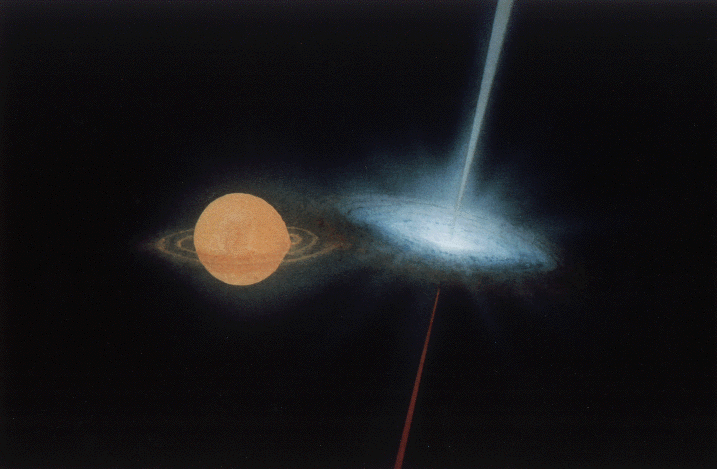
SS433 is one of the most exotic star systems known to astronomers. Its unremarkable name stems from its inclusion in a catalog of stars which emit radiation characteristic of atomic hydrogen . Its very remarkable behavior stems from a compact object, a black hole or neutron star , which has produced an accretion disk with jets. As illustrated in this artist's vision of the SS433 system based on observational data , a massive, hot star (left) is locked in a mutual orbit with a compact object. Material transfers from the massive star into an accretion disk surrounding the compact object blasting out two jets of ionized gas in opposite directions - at about 1/4 the speed of light ! Radiation from the jet tilted toward the observer is blueshifted, while radiation from the jet tilted away is redshifted . The binary system itself completes an orbit in about 13 days while the jets precess (wobble like a top) with a period of about 164 days. Are the jets from SS433 related to those from black holes at the centers of galaxies ?
Information: The Scale of the Universe Debate in April 1996
Media Credits & Attribution
Credit: NASA Artist's Visualization